Showing posts with label The Loremaster. Show all posts

Thursday, 19 September 2019

The Loremaster: Garruk Wildspeaker and the Holy Grail

SPOILERS.

Seriously, if you want to read The Wildered Quest without having anything spoiled, go buy it and read it first. It's only like, R75 for the e-book. I'll wait here.

Ok, so, what the hell was up with the magical cauldron that mysteriously appeared to save Will and Garruk from downing, cured Garruk of his curse, and then vanished without a trace?

Eldraine is in great part based on the legends of Camelot, and the cauldron is Eldraine's version of the Holy Grail. The writer could have set it up better, cause it seemed to mostly come out of nowhere, aside from a couple of previous offhand mentions of it having gone missing and that knight sometimes quest to find it. They could have made it a chalice instead of a cauldron, so the connection was a bit more obvious. So why did they turn the grail, which is usually some form of a goblet or chalice, into a cauldron, and why is it black rather than white? There is a good reason for it, and it lies in the origins of the grail stories.
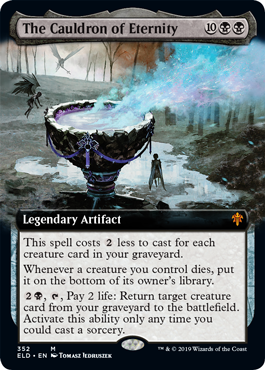
The Cauldron of Eternity

It would be understandable to think that the stories of the grail started in the Middle East, made their way west to England alongside Christianity, and were subsequently incorporated into the legends of King Arthur. But that's not what happened.

The French writer Chrétien de Troyes (often considered the first novelist) seemingly invented the Holy Grail, and the knightly quest to find it, for his romance Perceval ou le Conte du Graal. But while he was the first to use that name, he actually seems to have drawn on old Celtic legends about the inhuman Tuatha de Danann – who are basically high-fantasy style elves. The king of the Tuatha owned a magical cauldron that could restore the dead to life (which could be considered a form of necromancy, which is within the black part of the colour pie - though which can do it too). When Christianity came to England, many old stories and traditions were altered to fit within the new anti-pagan rules imposed by the emerging Christian clergy. Thus, the ancient inhuman king with powerful warriors became the Christian King Arthur and his noble knights, the magical cauldron became a chalice powered by the blood of Jesus, and the ancient wizard Merlin became...ok, for some reason Merlin survived mostly intact.
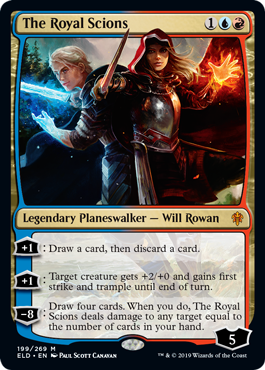
The Royal Scions

So, the cauldron is the grail. Attention is not drawn to it in the novel, but it is Will's selfless act to try and save Garruk from drowning that causes the Grail to appear to him. (Proving him to have a 'pure heart' or whatever you want to call it. ) If it hadn't appeared, he and Garruk would most likely have drowned. But whyis it necessary to invoke such a powerful artifact to cure Garruk? Why has nothing been able to fix him until now?

Garruk's curse stems from a story called The Hunter and the Veil that came out when I first started playing Magic. In the story Garruk realises that the necromancer Liliana Vess is trying to obtain an artifact called the Chain Veil, a powerful magical artifact from the plane of Shandalar. The Veil houses the souls of an entire race of incredibly evil ogre wizards called the Onnake, who were thankfully destroyed many years ago. They have never told us what sort of stuff the Onnake did that makes them so incredibly evil, but the story assures us that, yes, they are indeed incredibly evil, and it's a good thing they are all dead, otherwise they would be doing incredibly evil things of an unspecified nature.
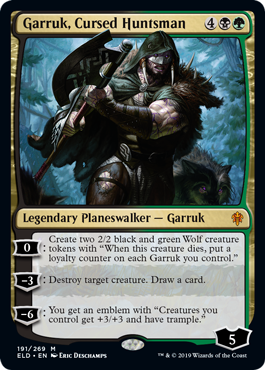
Garruk, Cursed Huntsman

Garruk intercepts Liliana on what he thinks is her way to the Onakke Catacombs where the veil is hidden, but unfortunately, it turns out that she is actually leaving the catacombs, having already obtained it. Garruk is more powerful than her, and almost defeats her, until she desperately draws on the Veil's power to unleash a corruptive curse on him. She escapes as the curse begins to drive Garruk slowly insane, whilst black mana spreads slowly and painfully through his veins.

Later it was revealed that this is not the first time the Veil's curse has been used on a planeswalker – Ob Nixilis was originally a human who tried to use the power of the Veil but was instead cursed by it. As Nixilis proceeded to then turn into a demon, it has been assumed that Garruk's curse is also slowly transforming him into one.

Ob Nixilis of the Black Oath (C14)Ob Nixilis, the Fallen (IMA)


So far the curse has been treated as pretty much unstoppable. We don't know much about it aside from it's effects on Nixilis and Garruk. Nahiri's lithomancy was able to suppress it in Nixilis (leading Jace to embed a hedron in Garruk to similar effect), but not cure it. Not even the immensely powerful Avacyn, who was able to cure madness, heal mortal wounds and cure many of the dual-nature werewolves by merging their savage and human halves together into the wolfir, was able to heal him. Unfortunately, we don't have a full explanation of why it has been so stubbornly hard to cure, which is why it would have been nice to have more of an explanation of where the Cauldron came from, and what it's exact nature and powers are. All we know is that it was originally looked after by Lochthwain, the black court, but vanished, and though many knights undertake a quest to find it, none have succeeded...or ever returned.

At any rate, there are still a lot of unanswered questions surrounding the Chain Veil and it's powers. Now that Bolas is dealt with, and Garruk is back to not-turning-into-a-crazed-demon, perhaps we can finally get some answers to those questions.

Friday, 29 June 2018

The Loremaster: Tezzeret


Tezzeret was born in Tidehollow, on Esper, one of the shards of Alara. Unlike most planeswalkers, Tezzeret has no surname. In fact, he didn't even have a name until, as a boy, he stabbed a bully with a shiv - tezzeret being the local slang for an improvised weapon. Tezzeret is a highly-intelligent gifted artificer. However, he has a rather explosive temper, and when he loses it, people tend to end up dead.

When he was seven years old, his mother was killed, run over by a guildmaster's carriage. That was when Tezzeret decided that he would do anything he could to become a powerful mage, so no one could ever take something from him again. To that end he began stealing small amounts of the rare, expensive and highly-in-demand magical alloy etherium, a metal that only a group called the Seekers of Carmot knew the secret to making. He was helped in this endeavor by discovering he had a natural talent for rhabdomancy, the magical ability to locate metal. With the money he earned from this, he joined the Machinist Guild, and at the age of 19, amputated his right arm, replacing it with an artificial limb made of etherium filigree. The guild immediately elevated Tezzeret to master status.


Using his newfound status, Tezzeret joined the Vectis City Academy, and applied for entry into the Seekers. In order to gain entry, he had to best Silas Renn in a dual, which he was unable to do. The Seekers denied him entry. Tezzeret worked hard to get a second chance, but kept being passed over. Finally, he had enough and broke into the Seeker's vault to steal the Codex Etherium...only to find that the pages were blank. The Seekers didn't know how to make etherium. No one did.

Unfortunately, this time Tezzeret got caught. When the Seekers tried to kill him to cover up their lies, his spark ignited, and he planeswalked to the shard of Grixis. There he met Nicol Bolas - who offered him power if he would work for Bolas.


For some unknown reason, Nicol Bolas appears to actually care about Tezzeret. Most of his minions find themselves discarded and killed if they fail him, rebel against him, or just outlive their usefulness. But Bolas has spent great effort and considerable rescources to bring Tezzeret back in line when he strays (which has happened multiple times).

Tezzeret, for his part, deeply resents Nicol Bolas for his role in creating the Seekers, as he spent much of his life working to become one, only to find that their teachings were all lies. But, Nicol Bolas did promise him power, and has delivered on that promise.

Tezzeret was placed in charge of one of Bolas' organisations, the Inifinite Consortium, which exploited the power vacuum on Ravnica in the aftermath of the original Ravnica storyline. He repaid Bolas by assassinating everyone who knew the Consortium answered to Bolas, and taking it for himself. It worked, for many years Tezzeret operated with impunity - until Liliana, who was secretly working for Nicol Bolas, manipulated him into starting a war with Jace Beleren. The war ended with Jace erasing Tezzzeret's mind, cutting off his etherium arm, and leaving him in the hands of the nezumi on the plane of Kamigawa.


Bolas managed to retrive Tezzeret and spent months rebuilding his mind and body. He then sent Tezzeret to New Phyrexia to keep an eye on the Phyrexians, and sabotage their leadership structure. At some point after this, he was ordered to relocate to Kaladesh, where he infiltrated the government (known as the Consulate) and was eventually appointed Grand Consul. He used his power to seize control of a powerful artifact Bolas needed - the Planar Bridge - and despite the fact that Jace and the Gatewatch blew it up, Tezzeret escaped with the core, allowing him to rebuild the Bridge, and later, use it to transport another powerful artifact - the Immortal Sun.

Both artifacts seem to be of great importance to Bolas' decade-spanning plans, though exactly what he plans on doing with them is still unclear. One thing is for sure, when Bolas enacts his endgame, Tezzeret will be right there too.

Monday, 25 June 2018

The Loremaster: Ajani Goldmane


Ajani Goldmane was one of the first five planeswalker cards, printed in Lorwyn. We knew little about him, as the Lorwyn 5 didn't actually show up in the storyline of Lorwyn, but he was interesting in that he was a grizzled and battle-scarred leonin with abilities that didn't really fit that sort of image - mostly he was about healing and protection.

We didn't have to wait very long to get Ajani's origin, however. He was born on Alara, a plane that had long ago been split into five pieces called shards. Ajani was from Naya, a jungle covered shard linked to white, green and red mana. Due to being born an albino with white fur, Ajani was shunned by all the other leonin, aside from his brother Jazal. Not even his royal blood (Jazal was kha, or king, of the leonin) saved him from their derision.


The five shards of Alara were on a collision course with each other. When they collided, Alara would be reunited, but a nexus of powerful energy called 'the Maelstrom' would be formed. The ancient dragon-planeswalker Nicol Bolas was dying of old age, and, believing the nexus could restore him, enacted a plan to empower it. If the inhabitants of the shards went to war with each other, the excess energy of spells that they cast in battle would be gathered by the Maelstrom. there were a few obstacles to his goal - one was that Jazal was a rather moderate leader, unlikely to be drawn into a war. Furthermore, he may have convinced the elves and humans of Naya to remain neutral as well.

So Nicol Bolas had Jazal assassinated. His plan succeeded (Naya did later go to war), but he inadvertently made an enemy of Ajani, whose spark ignited due to the trauma of his brother's death. Planeswalking to another shard - Jund - Ajani met the planeswalker Sarkhan Vol, who explained to Ajani that he was a Planeswalker. Sarkhan (sounding very Sith) encouraged him to take hold of his anger and use it to track down his brother's killer. He also showed Ajani how to planeswalk back to Naya.


Whilst on the trail of Nicol Bolas, he was attacked by another leonin and severely injured. Planeswaking away, he found himself on another shard - Bant - where he was rescued and healed by a third planeswalker, the knight-errant Elspeth Tirel.

Eventually Ajani, with the help of a combined army of elves and leonin, managed to track down and confront Nicol Bolas. Bolas absorbed the Maelstrom Nexus, restoring his youth and much of his power. But he underestimated Ajani, who blindsided the elder dragon by absorbing the remeining energy of the Maelstrom and using it to create a reflection of Bolas that banished the dragon from Alara forever.


At some point after the events of Alara, Ajani joined an unofficial group of planeswalkers that also included Tamiyo, Elspeth and Narset. Dubbed the 'Story Circle' they travelled the multiverse collecting stories.

Elspeth was a rather broken soul, having been tourtured by Phyrexians when she was young (which would make her one of the oldest living planeswalkers). But Ajani felt he owed a debt to Elspeth for healing him. After failing to get her to return to Bant from a self-destructive sojourn on Dominara, he followed her to the plane of Theros. Though he helped her succeed on her quest to defeat the evil planeswalker/god Xenegos, he was unable to prevent her from being killed by the sun god Heliod. But this time Ajani's vengeance took a very different form. Donning Elspeth's iconic cloak, he traveled the length and breadth of Theros, telling all about the bravery of Elsepth, and about the betrayal of her supposed patron Heliod. The gods of Theros derive their power from their worshipers, and Ajani's tales have turned many away from following the sun god.


Eventually Ajani felt the story of Espeth had become widespread enough that it would continue to be told without him, and he left Theros, travelling to Kamigawa to tell Tamiyo of Elspeth's death, and giving us the awesome scene of Tamiyo's little children clambering all over Ajani demanding he tell them stories.

But Ajani had one more task to take care of - Elspeth had told him of the planeswalker Tezzeret's actions on New Phyrexia, so when Tamiyo told him of crimes committed by his followers on Kamigawa, Ajani decided to track down the renegade artificer and bring him to justice. Tracking Tezzeret to the plane of Kaladesh, Ajani fell in with the Gatwewatch - a group of planeswalkers consisting of Gideon, Jace, Liliana, Chandra and Nissa - and helped them defeat the oppressive Kaladeshi Consulate, but not before Tezzeret revealed he was working for Nicol Bolas, and made of with a powerful 'planar bridge', which would allow Bolas to transport objects between different planes.

Although the Gatewatch wished to confront Bolas immediately, Ajani was no fool, and admitted that while he had defeated Bolas in the past, the elder dragon had been caught off guard, and would not be defeated so easily again. Ajani left to find others to help fight the dragon. Meanwhile, the Gatewatch ignored him, and...well...lets say that ended badly for them...

Friday, 26 January 2018

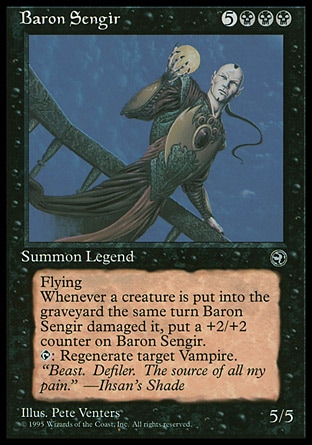
The Loremaster: The Strange Tale of Ravi Sengir


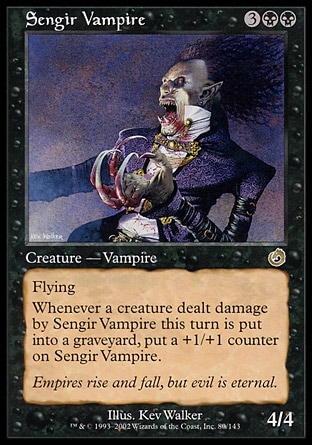
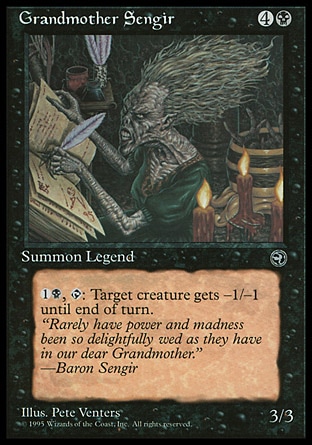
You have probably heard of Barin Sengir, or his progeny, the Sengir Vampires. What you probably didn't know, was that his grandmother, Ravi Sengir, was a powerful planeswalker from Dominaria.


Ok, so, she wasn't actually his grandmother. She did, however, have a significant role in the baron's origins. When Ravi was a young girl, a plague swept through her village, killing her mother. At her funeral, Ravi met the future baron as young man, who told her that his father was responsible for the plague, having unleashed infected rats on the village in order to study the effects of black magic. The only way to save the village was to kill his father, said the boy, and he taught her how to control rats with a song. The reason Ravi had to kill him was that the law prevented a son who killed his father from inheriting his lands and title (which was, of course, Baron).

Ravi was hesitant at first, but after her father died from plague too, she attacked the elder baron's castle with controlled rats. The two youngsters, however, had neglected to remember that the elder baron could control the rats with his music too, and thus an epic rap battle was fought for control of the rats. Confised, that rats attacked and killed the only person who wasn't singing, the young future baron. Horrified, the elder baron stopped singing to cast a spell - allowing Ravi to use the rats to kill him. The younger baron had been restored to (un)life by his father's spell - now and forever he was Baron Sengir, vampire lord.


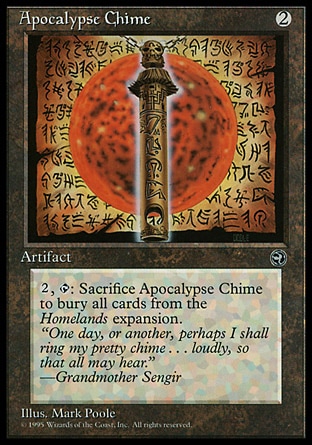
Years later, Ravi ascended and became embroiled in a war between two factions of planeswalkers on the plane of Ulgrotha. In an attempt to end the war, she used a powerful artifact: the Apocalypse Chime. After ringing it, she sealed herself inside a magical coffin to escape its effects. The Chime was, however, even more powerful than Ravi realised. Not only did it kill all planeswalkers on both sides of the war, it killed almost everything on the plane, and disrupted the plane's leylines, ripping away all of Ravi's mana bonds to the land - now unable to planeswalk away, she was trapped inside the coffin for centuries. The destruction spread further than Ulgorotha, affecting the nearby planes of Dominaria and Kamigawa, and forming rifts that linked the three planes together.

The rifts created by the Chime allowed the Myojin of Night's Reach and Toshi Umezawa to travel from Kamigawa to Dominaria. Toshi's desendant, Tetsuo Umezawa, later defeated the Emperor of Madara, Nicol Bolas, coming perilously close to killing the dragon with a meteor hammer. Thus, Ravi is indirectly responsible for the downfall of Nicol Bolas and his 400 year exile. Lets hope Bolas never finds that out.

As for Ravi, she was imprisoned for over 300 years, long enough to drive her completely insane. She didn't even remember who she was - or recognise the man who eventually opened her coffin - Baron Sengir. Due to retcons, there is corrently no offical explanation for how the Baron ended up on Ulgrotha - but we can probably go with the easiest: 'He traveled there via one of the apocalypse rifts'.


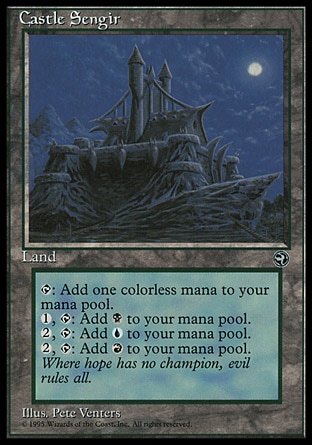
The Baron gave a place at his castle on Ulgrotha, the aptly named Castle Sengir, and told everyone she was his grandmother. But all of these stories serve as mere backdrop for the Homelands set - though we are told they are evil, in the actual Homeland comics, the Sengirs don't do anything important at all. Instead, the story is focused on Feroz and Serra falling in love, and on Sandruu and Taysir fighting over Kristina (for such a backwater plane, Ulgrotha certainly attracts a lot of high-power planeswalkers). The Baron is actually quite pleasant towards Feroz and Serra, and after their deaths he seems genuinely sad, leaving a rose on Serra's gravestone.

While Serra's story is about the effect of loss and grief, and Kristina's is about the dire consequences of jealousy, I am left wondering what exactly the point of Ravi's story is. Her descruction of Ulgrotha in the distant past has no emotional impact on us, as we didn't see Ulgrotha before the Chime, and we are not given any information on any of the planeswalkers who Ravi killed. The story also makes it clear that the Baron wasn't looking for her, and his freeing her was nothing but coincidence, which is an odd angle to go for. Perhaps the story was written merely to set up the rifts, to allow laters stories to feature travel between Dominara, Ulgrotha and Kamigawa.

Thursday, 14 April 2016

The Loremaster: Nahiri, the Lithomancer

The colours of magic each have a staple creature type: Green has elves, Red has goblins, Black has vampires, Blue has merfolk, and White has soldiers. One of these is not the same as the others.

The powers that be have tried to fix the soldiers-are-not-a-race a number of times. One of the more successful attempts is the kor, a slender, agile, pointy-eared race with pale blue skin, white hair, and a strong sense of wanderlust.


Many roam the plains of Zendikar and Dominaria, driven to explore (or as they prefer to call it, returning to lands forgotten). They are excellent rockclimbers, skilled in the use of hooks and ropes. They are also considered to be excellent blacksmiths, though their methods of forging weapons are unusual.So are thier choices of weapons - they are as likely to fight with their rock climbing gear as they are with swords. A kor wielding hooks and rope in battle is surprisingly effective.

Thursday, 7 April 2016

The Loremaster: The Nightwalker

You may have noticed I've said a lot about Leshrac lately. The reason is, I had made a custom commanderwalker card of him to hand out at the ICON by the Sea Commander game, as a sort of promotional come-play-Commander-at-the-Unseen-Shoppe sort of thing. He is obviously, not a real card (it says so), has no actual value, and can only be played at the casual Commander games I host at the Unseen Shoppe.


Sadly, the printed Leshrac cards were not as good quality as I was hoping due to various circumstances. But hey, there's always next year.

Why Leshrac though? I wanted a planeswalker I could link to the Unseen Shop that made sense. Leshrac is the Nightwalker, the background unseen force behind Lim-Dûl's rise to power and has links to a sort of dimension called the Nether Void, which has associations with the shadow mechanic. I patterned him after Freyalise and company and tried to give him abilities that both worked well in commander and made sense based on his character. Thus, he will give everyone power (for a price), can make creatures 'unseen', and will unleash great destruction in the pursuit of power.

Tuesday, 22 March 2016

The Loremaster: The Goblin Tinker

At first the five commanderwalkers of Commander 2014 seem to be quite a mixed bag. Freyalise and Teferi had been around for most of Magic's history, bearing the affectionate title of 'oldwalker'. Nahiri and Ob Nixilis we knew of as much more recent creations, being introduced a few years ago in Zendikar's storyline. And Daretti was a completely new character.


But then, as stories were filled out, it turned out that these five had more in common with each other than initially thought. The imprisonment of the Eldrazi on Zendikar had taken place far, far earlier than we realised - at least a thousand years before the Brother's War - making Nahiri, if she still lived, significantly older than Freyalise and Teferi. Ob Nixilis is also rather ancient. By virtue of the fact that he must have fought Nahiri at sometime before she left Zendikar, he has to be an oldwalker as well.

Though we now have a lot of story involving the other four, we still know very little about Daretti. He is, of course, a goblin. He is from the High City of Paliano, on the plane of Fiora, the setting of the Conspiracy sets. He was a gifted artificer, employed at the Academy of Palino. Though he held high rank, many of the other artificers viewed him with disdain, possibly due to the fact that he was a sort of 'repurposer', building his cogwork contraptions out of scrap metal and broken artifacts.

Thursday, 17 March 2016

The Loremaster: Teferi, Time Lord

Teferi of Zhalfir. Arguably the most powerful time wizard in the history of Magic, he probably disagreed with Urza more than any other planeswalker of the time. The central conflict between the two was that Urza was obsessed with destroying Phyrexia at any cost, while Teferi cared more about protecting people from Phyrexia than winning a possible future war.


Teferi has been a part of Magic for a very long time. He first appeared twenty years ago, during the Mirage block, already a fully fledged planeswalker. Mirage took place on the continent of Jamuura in Dominaria. Jamuura, consisting of Femeref, Suq'Ata and Teferi's homeland of Zhalfir, was Magic's version of Africa. Now Mirage block wasn't perfect. It did have some...shall we say...racial stereotyping in it. But it also had a very powerful good-aligned planeswalker who was not only black-skinned, but very African in tone. Which is pretty cool. Teferi was also a rather more sympathetic character than Urza, and genuinely cared about his homeland and people.

But if we are to start at the beginning, we must go forward a few sets to the Urza's Saga block, which takes place chronologically before Mirage.

Friday, 11 March 2016

The Loremaster: Ob Nixilis and Garruk Wildspeaker

Most of the original five planeswalker cards had their ups and downs in standard. There were times when they were really good, and times when they were terrible. Only Garruk Wildspeaker was consistant. Never amazing, but never bad, just always good. It says a lot that he is the only planeswalker ever reprinted in a Commander set.


Of course, he's not the only walker found in a Commander set. Commander 2014 feaured five new planeswalkers, specially designed for the format. But they messed up a bit with their announcement. Revealing Teferi without further comment created the expectation that it would be a whole cycle of pre-Time spiral walkers (known as 'Oldwalkers'). I certainly, was very excited at the possibility of Freyalise in green, and to a lesser extent, Leshrac for black.

Tuesday, 1 March 2016

The Loremaster: Freyalise, Phyrexia and the End of Time Itself

This is part two of a look at the life of Freyalise. Part one can be found here.


Last week, we left the story with Freyalise casting the World Spell to end Dominaria's Ice Age. We are not sure what Freyalise did for the next 1000 years, apart from the fact that she spent at least some of the time on Shandalar. This is mostly due to Wizards cancelling the comic book line so they could focus on the Weatherlight Saga. Prepare for lots of Urza in the spotlight.

Urza, obsessed with defeating Phyrexia, would spend the same thousand years on Dominaria concocting overly complicated plots involving time travel experiments, genetically engineering super soldiers, uniting Dominaria into a massive Coalition, and crafting a number of powerful artifacts that would eventually combine to form the Legacy Weapon.

Just before the Phyrexians invaded Dominaria, Urza seemed to remember that he was not the only planeswalker who cared about Dominaria, and set out to sway a number of them to his side. They would be called the Nine Titans. Besides Urza, the Titans included the panther warrior Lord Windgrace, Kristina of the Woods, Taysir and his daughter Daria, Freyalise and - of all people - Tevesh Szat. Teferi had been invited as well, but refused due to his numerous disagreements with Urza's methods.

Wednesday, 24 February 2016

The Loremaster: Freyalise and the Ice Age


When it was revealed that Commander 2014 would include older planeswalkers like Teferi, I said something a bit silly. 'If they don't make Freyalise,' I said, 'I will quit Magic.'

Fortunately, they did make Freyalise and I did not have to make good on my threat. But it did open a can of worms. Because Freyalise died during the events of the Time Spiral block. And part of the justification for her death was that Wizards wanted planeswalkers to have cards - she belonged to the older generation of near-omnipotent planeswalkers, and therefore was too powerful to have a card.

And yet here we stand with a Freyalise planeswalker card.


It is somewhat difficult to relate the early part of Freyalise's life. The comics that tell of it were written before the concept of a planeswalker 'spark' existed, and...well, frankly, they are a mess that makes very little sense. But I will try regardless.

Freyalise was a pyromancer living in Storgard, on the plane of Dominaria, during the Ice Age. Storgard was the last of the Fallen Empires, located in the terminal morraine of a vast glacier, and therefore constantly under threat of the growing ice. Freyalise was a bit of an oddity - she was a half-elf, something seen very rarely in the lore of Magic.

Wednesday, 17 February 2016

The Loremaster: Nicol Bolos, Elder Dragon

MtG: Commander was originally called Elder Dragon Highlander. Highlander, because there can be only one. Elder Dragon, after a cycle of cards printed in Magic's third expansion set, Legends. They were dragons. They were big. They were splashy. They were three colours. They were...mostly not very good. But in Commander, it's ok to be bad if you're a powerful dragon from the dawn of Magic.

In the beginning were the Elder Dragons, who ruled the plane of Dominaria 25 000 years ago. Being dragons, they made war upon each other, until only five were left - Nicol Bolas, his brothers Arcades and Chromium, his sister Palladia-Mors, and their cousin, Vaevictis Asmadi. The other Elders were slain, or cast down and stripped of their power.

The children of Bolas and his relatives were also considered to be elders, though lesser in power. It is said these lesser elders gave rise to all the dragons of Dominaria. The cast down Elders were no longer even called dragons, and their children became the drakes and wurms.

Because scarves are cool.