Originally published in issue 9 of 'The Scene Unseen' newsletter.
In my two-year Pathfinder campaign I made a lot of mistakes, but also had some unexpected successes.
The runaway success in my campaign was the character who ended up being the main villain, Lucretia. In the Adventure Path I was following, she was only a minor stumbling block on the way to bigger and better baddies, but she caught the attention of the party like nobody else had. Something about her grabbed their attention. What exactly was it? She managed to escape them during their first battle, but she was not the first villain to do that. There was an aboleth (a giant psychic fish monster) who escaped them on multiple occasions, but the level of animosity the players had towards him was far less than against Lucretia.
There was a point, earlier than their first meeting with Lucretia, in which I realised I had given the players too much treasure. A large part of that was to do with them coming up with a plan to sell a house in Sea Gate, the deed to which they had found. In a locked chest. After killing the owners. Who were, to be fair, rather evil. The AP didn't actually account for this possibility, and in hindsight, instead of letting them successfully sell it for a lot of gold, I should have had the city guard show up and chastise them for trying to con the good people of Sea Gate, and have them narrowly escape some prison time.
At any rate, things had gotten to the point that if villains were going to survive more than a single round against my player, they had to be a much higher level than them. But that put their damage output to dangerous levels. Whichever side got off a full attack first was going to straight up kill the other side. Which is not a great point to be at. So I had to somehow eliminate my player's most valuable items, to bring them back into line with where they should be. Someone suggested making them fight rust monsters, but I thought they were a bit too random, I wouldn't have much control over which items they destroyed.
Enter Lucretia. What if she had been plotting this whole time, planting cursed items in various places, including on her underlings that they had already killed, so that by the time she had to fight them, she could cause chaos by messing with the groups items? She was my fix for a trap that new GMs fall into, that of giving the players all the stuff they want. (At least, I hope it's not just me.)
The group fought Lucretia in a fort that had been taken over by giants. Despite her ambushing them just after they killed the leader of the giants, they still almost killed her. The only reason she survived was due to her messing with their stuff. The paladin's favourite weapon was a light-infused greathammer that dazzled anything it struck. Now it flared with light everytime he used it, temporarily blinding him and causing him to miss. The goblin's dexterity-boosting shirt (in my defense this was an actual item from the campaign, whoever thought this was balanced should be shot) entangled him, and had to be ripped in two for him to escape. Thr cleric's trident dealt extra damage...by drawing on the cleric's life force, injuring him every time he used it, not good for a squishy merfolk. And the sorcerer's fear-protecting ring started amplifying his fears instead of removing them. Only the cavalier escaped unscathed, mostly because he was a miser that refused to spend his gold on anything except mithral armour and weapons.
Then she realised she had 2 hit points left, summoned a wall of water, and ran away.
Lucretia had escaped and outwitted the group (barely) in their first major battle, which was bad enough, but she also permanently harmed and traumatised them by taking away their stuff. It's amazing how players can get attached to imaginary stuff. Strangely, though, the cavlier was just as bent on finding her and eliminating her, despite her not doing anything to him directly, and over the course of the campaign, reminded the rest of the group that they still had to deal with her. When I asked him why he was so keen on stopping her, he replied that it was due to her sister dropping a cathedral bell on him earlier in the campaign - despite the fact that Lucrecia had nothing to do with it.
So what is the point of all this? If you want your players to care about a villain, you have to make them somehow invested in bringing her (or him) down. Having them permanently harm the characters in some way worked for my group, but. But just as much, your players need to buy into the narrative (even if thier thinking is a little flawed, as in the case of the cavalier). You can have the best villain, but for some reason your players don't care. If this is the case, you may have to let go of your villain, despite how much you like them, and look to see if there is another enemy that is better suited to the group.

Showing posts with label Roleplaying Games. Show all posts
Showing posts with label Roleplaying Games. Show all posts
Tuesday, 20 February 2018
Tuesday, 6 February 2018
Dungeoneering: The Death Lord
Originally published in issue 4 of 'The Scene Unseen' newsletter.
It's been a long time since a goblin rogue, a merfolk cleric, a human knight and a dragonblood sorcerer first met, saved the small town of Stoneforge from a band of maurauding goblins, and learned that on Zendikar, everything is always out to kill you. I've been running the Pathfinders of Zendikar campaign for one and a half years now, and as it draws to a close, I find myself thinking of all the unexpected stuff has happened. Where once the continent of Tazeem was an untamed wilderness with only brief descriptions of notable places, a few characters from the card, and just three mentioned gods, it now has a fully fleshed out fortified town, three cities, and many interesting people and places.


It might seem strange to have a non-evil god of death, but Pathfinder had already gone down this route with their own death goddess. Pharasma is true neutral, sends the spirits of the dead off to their eternal reward (or punishment) without bias, and is adamant that dead things should remain dead, viewing undeath as a perversion of the natural order. Her followers hunt down the undead even more fanatically than paladins do. Vaasgoth is similar, but shifted towards the legalistic side, with a focus on enforcing the laws of mortality, and requiring those who walk close to death (like vampires) to act nobly, lawfully and ethically, lest they find this privilege taken away from them.
Vaasgoth ended up being not only the patron of Clan Kalastria, but also of the near-extinct Clan Sorn, a house I created on the spur of the moment to save a player character from death, now a house reborn after the marriage of Dragor Sorn to Tyri Kalastria. Vaasgoth then branched out into other races, being linked to the death-revering (but ultimately useful) Mul Daya elves led by the shaman Mira Sarith. And of course, hovering quietly in the background the whole time was Stoneforge's resident mistrusted ogre, Victor Creed, who turned out to be a rather pleasant and knowledgeable High Inquisitor of Vaasgoth, and eventually granted my players a boon that makes it harder for them to die. (Because I'm so good at killing players I need to give them extra resilience to stop it happening so much.)

And so, like the gods of Terry Prachett's Discworld, Vaasgoth exists because people believe in him. It was a thing that just happened because it needed to, but it turns out, it does have precedence in Magic, as the gods of Theros were revealed to work this way, and there are some hints that Amonkhet operates similarly. It also, usefully, gives me reason to divorce the only lore-mentioned gods - the merfolk deities Emeria, Ula and Cosi - from their origins as warped memories of the Eldazi Titans. They were based on them at first, but now they exist separately.
Vaasgoth's presence has spread rapidly due to in-game events, such as House Sorn and Creed uniting to build a temple in Stoneforge. The town, now heavily fortified after multiple attacks by giants and dragons, already had one to Emeria - meaning that it now has temples to two different lawful gods, an interesting development. One that will probably come up if people visit Stoneforge in my sequel campaign.

There is something to be said for having all of the mythology in place from the beginning. On the other hand, I think it is nice that my players have had a significant effect on the world in a way not directly related to killing a bunch of bad guys. House Sorn would still be a minor footnote in history without their actions, and Creed would not have had to reveal his true nature, making people look at ogres in a new light. The temple to Vaasgoth exists because of them, and their infuence spreads way beyond even this. Should they survive the final battle, they may very well show up as powerful allies (or even enemies) in future campaigns.
It's been a long time since a goblin rogue, a merfolk cleric, a human knight and a dragonblood sorcerer first met, saved the small town of Stoneforge from a band of maurauding goblins, and learned that on Zendikar, everything is always out to kill you. I've been running the Pathfinders of Zendikar campaign for one and a half years now, and as it draws to a close, I find myself thinking of all the unexpected stuff has happened. Where once the continent of Tazeem was an untamed wilderness with only brief descriptions of notable places, a few characters from the card, and just three mentioned gods, it now has a fully fleshed out fortified town, three cities, and many interesting people and places.

At first I was very hesitant to add things to Zendikar that were not estabished lore. But in the case of gods, I had to, as the Pathfinder mechanics for clerics require their existance, and for them to each be tied to various domains and alignments. Needing a lawful neutral god, I created the death god Vaasgoth, and built his identity in a way that facilitated playing a vampire from the non-evil Clan Kalastria. Vampires on Zendikar imitate many aspects of undeath without actually being undead, and can survive perfectly well on the blood of animals, allowing them to choose not to hunt down humans and the other races for nourishment (though many of them do anyway). It was not really necessary, as we later discovered that playing as a vampire is hard on your allies, as your connection to the negative energy of death makes it difficult for healers to heal you. At any rate, Vaasgoth existed as a story hook. He was intended to be misremembered tales about the planeswalker Sorin Markov, and thus, not actually exist. A minor role if there ever was one.
It might seem strange to have a non-evil god of death, but Pathfinder had already gone down this route with their own death goddess. Pharasma is true neutral, sends the spirits of the dead off to their eternal reward (or punishment) without bias, and is adamant that dead things should remain dead, viewing undeath as a perversion of the natural order. Her followers hunt down the undead even more fanatically than paladins do. Vaasgoth is similar, but shifted towards the legalistic side, with a focus on enforcing the laws of mortality, and requiring those who walk close to death (like vampires) to act nobly, lawfully and ethically, lest they find this privilege taken away from them.
Vaasgoth ended up being not only the patron of Clan Kalastria, but also of the near-extinct Clan Sorn, a house I created on the spur of the moment to save a player character from death, now a house reborn after the marriage of Dragor Sorn to Tyri Kalastria. Vaasgoth then branched out into other races, being linked to the death-revering (but ultimately useful) Mul Daya elves led by the shaman Mira Sarith. And of course, hovering quietly in the background the whole time was Stoneforge's resident mistrusted ogre, Victor Creed, who turned out to be a rather pleasant and knowledgeable High Inquisitor of Vaasgoth, and eventually granted my players a boon that makes it harder for them to die. (Because I'm so good at killing players I need to give them extra resilience to stop it happening so much.)
And so, like the gods of Terry Prachett's Discworld, Vaasgoth exists because people believe in him. It was a thing that just happened because it needed to, but it turns out, it does have precedence in Magic, as the gods of Theros were revealed to work this way, and there are some hints that Amonkhet operates similarly. It also, usefully, gives me reason to divorce the only lore-mentioned gods - the merfolk deities Emeria, Ula and Cosi - from their origins as warped memories of the Eldazi Titans. They were based on them at first, but now they exist separately.
Vaasgoth's presence has spread rapidly due to in-game events, such as House Sorn and Creed uniting to build a temple in Stoneforge. The town, now heavily fortified after multiple attacks by giants and dragons, already had one to Emeria - meaning that it now has temples to two different lawful gods, an interesting development. One that will probably come up if people visit Stoneforge in my sequel campaign.
There is something to be said for having all of the mythology in place from the beginning. On the other hand, I think it is nice that my players have had a significant effect on the world in a way not directly related to killing a bunch of bad guys. House Sorn would still be a minor footnote in history without their actions, and Creed would not have had to reveal his true nature, making people look at ogres in a new light. The temple to Vaasgoth exists because of them, and their infuence spreads way beyond even this. Should they survive the final battle, they may very well show up as powerful allies (or even enemies) in future campaigns.
Tuesday, 30 January 2018
Dungeoneering: A Kind of Magic
Surprisingly, spellcasting in D&D Pathfinder actually has it's origins in historical tabletop wargames. Players began to ask things like "If we can recreate Waterloo, why not the Battle of the Five Armies?" The next question was how to include spellcasters like Gandalf. The easiest way to slot them in was to base them on units that already existed, with some tweaks to the rules. Wizard units in these fantasy tabletop wargames were based on artillery - they had powerful long-range damage, but had limited ammunition and little protection if an enemy unit could get into melee with them.
The limited ammunition idea coincided neatly with the depiction of magic in the novels of Jack Vance, and thus was coined the term Vancian magic. In his novels, wizards had to study their spellbooks to prepare spells. They could only memorise a certain number of spells at once, and once they had been cast, the spells faded from memory until the wizard could take time to study thier spellbooks once again. When smaller-scale roleplaying games developed - where each player had a single character unit instead of an entire army - the Vancian system was retained.
There are two main types of magic in D&D and Pathfinder: arcane and divine. Arcane magic is used by sorcerers, wizards and bards, stemming from the caster having a connection to the essence of magic itself. Divine magic is used by clerics, paladins, druids and rangers, and is magic granted by devotion to a deity or some sort of ideal or concept, like nature. Later versions of D&D have split off the nature classes like druid and ranger, and classed their magic as a third kind, 'primal'. Pathfinder still views them as divine casters, but has also added a third kind of magic - psychic. I have included more info on each of Pathfinder's magic categories below.

Arcane Magic
Wizard, Witch, Sorcerer, Magus, Bard
All arcane spells have two main components, called verbal and somatic. Think of the spells in the Harry Potter novels - each one has words that must be said (verbal), and a gesture that one must do with the wand (somatic). You don't need a wand in Pathfinder, however. These two components mean that it can be easy to shut down wizards - if they are gagged, put into a zone of silence, or have their hands tied up, they will be unable to cast spells. Arcane spellcasters are limited in what armour they can wear, as any armour besides the expensive mithral chain shirt will interfere with their somatic component. (And yes, that is very much a Hobbit reference.)
The wizards of Pathfinder, like the old tabletop wizards, still have to walk around carrying spellbooks filled with their spells. They must spend time consulting them at the beginning of each day, in order to prepare a number of spells up to the maximum number they can cast each day. These days, they are usually referred to as prepared spellcasters. The wizard class is extremely powerful, with access to a wide variety of spells for every occasion, but the preparation rules limit them significantly, as they can easily get stuck with prepared spells that are useless for the current situation.
Many people greatly dislike the preparation rules. The sorcerer class was made as an attempt to alleviate the problems with it. Sorcerers are based on a different sort of literary magic user - one born with inherent magical abilities, who does not need to learn magic. Sorcerers are called spontaneous spellcasters and don't have spell books. They don't need to prepare, but can choose to cast any spell they know, as long as they don't exceed the maximum number of spells they cast per day. They are, however, limited in spell knowledge - they only know a small number of spells compared to wizards.
Witches are prepared arcane casters, but have a significantly different spell list to wizards and sorcerers, a list that included a lot of spells previously only castable by clerics and druids. Witches cast these formerly divine-only spells as arcane spells, thus blurring the lines between arcane and divine magic.
Divine Magic
Cleric, Oracle, Inquisitor, Paladin; Druid, Shaman, Ranger
Compared to arcane spellcasters, divine casters have it easy. They don't need spellbooks, can use armour without worrying about spell failure, and prepared divine casters like clerics and druids know every divine spell that it is possible for them to cast. Need a niche spell to pull off a clever strategy? If you have enough time, they can just prepare it and you're good. They even have better health and attack bonuses than the arcane classes! (Prepared divine casters, like oracles, do have a limited amount of known spells, like sorcerers.)
Much of their magic still uses verbal and somatic components, making them susceptible to the same things that shut down arcane spellcasters. In addition, their magic requires a divine focus - a holy symbol for the more religious classes, or a sprig of mistletoe for those of a natural persuasion. Deprive them of their focus, and they can't cast spells. They are easy and cheap to replace, unless you want them to be really fancy.
I personally think it is silly that the three nature-focused spellcasters are lumped in with the divine casters, and in my games I usually make it hard for each group to recognise spells cast by the other - like how arcane and divine spellcasters struggle to recognise each other's spells.
Mechanically, there's not a lot of difference between arcane, divine and nature-divine magic, it's more of a story thing that needs to be played up by the GM and players for it to actually be relevant. Psychic magic, on the other hand...
Psychic Magic
Psychic, Occultist, Spiritualist
Psychic magic is both elegant and problematic. D&D's psychic classes had spell-like powers that worked completely differently to other spellcasters. Pathfinder decided that they didn't want people to have to learn a whole new system of 'spellcasting'. So they decided that psychic magic would work just like arcane magic, with a two key differences.
Instead of the normal components, psychic magic uses emotion and thought components. This means that most of the usual ways to stop spellcasters, like silence and binding their hands, doesn't work on them. But, anything that messes with their emotions - like a fear spell - will shut off their ability to cast. The intense thought required also means they have difficulty casting defensively, making melee combat even less desirable for them than it is for wizards.
Secondly, all psychic classes use spontaneous casting. Prepared casting for psychic magic does not exist.
The problem with psychic magic being slotted into the game this way is that, despite the fact that you can always tell when a spellcaster is casting a spell, the game doesn't explain how this works for psychic magic. Wizards, clerics and druids visibly move their hands and mutter incantations, but psychics do not. You can't see the psychic components. So we have to come up with our own explanation. Perhaps their eyes glow blue, or mystical sigils appear in the air around them, or you just get this nagging feeling that the guy in the corner is trying to read your mind. It's not hard to come up with something fun for it, but it makes for a lot of initial confusion when you are trying to work out how to play one, as it isn't brought up at all, and you have to go searching through forums to find an official answer, that yes, you can always tell.
Alchemy
Alchemist, Investigator
Alchemy is actually just arcane magic. However, the mechanics used by alchemists and investigators (a class inspired by Arkham Horror) circumvent many of the limitations of arcane magic. They actually 'cast' all their spells at the beginning of the day, by creating extracts, which basically act as potions that they can later drink. While preparing extracts requires components, drinking an extract does not, and has no risk of spell failure. Alchemists and investigators can basically cheat their way around the restrictions by only putting on their armour after preparing extracts, and don't care about Silence. They are not without drawback - that their spell list is a lot more limited than wizards or sorcerers, mostly defensive spells that affect only them, and lack the three highest spell levels.
In all other ways, alchemists and investigators mirror wizards - they have a formula book with all their extracts written down, and they prepare them in advance.
The limited ammunition idea coincided neatly with the depiction of magic in the novels of Jack Vance, and thus was coined the term Vancian magic. In his novels, wizards had to study their spellbooks to prepare spells. They could only memorise a certain number of spells at once, and once they had been cast, the spells faded from memory until the wizard could take time to study thier spellbooks once again. When smaller-scale roleplaying games developed - where each player had a single character unit instead of an entire army - the Vancian system was retained.
There are two main types of magic in D&D and Pathfinder: arcane and divine. Arcane magic is used by sorcerers, wizards and bards, stemming from the caster having a connection to the essence of magic itself. Divine magic is used by clerics, paladins, druids and rangers, and is magic granted by devotion to a deity or some sort of ideal or concept, like nature. Later versions of D&D have split off the nature classes like druid and ranger, and classed their magic as a third kind, 'primal'. Pathfinder still views them as divine casters, but has also added a third kind of magic - psychic. I have included more info on each of Pathfinder's magic categories below.

Arcane Magic
Wizard, Witch, Sorcerer, Magus, Bard
All arcane spells have two main components, called verbal and somatic. Think of the spells in the Harry Potter novels - each one has words that must be said (verbal), and a gesture that one must do with the wand (somatic). You don't need a wand in Pathfinder, however. These two components mean that it can be easy to shut down wizards - if they are gagged, put into a zone of silence, or have their hands tied up, they will be unable to cast spells. Arcane spellcasters are limited in what armour they can wear, as any armour besides the expensive mithral chain shirt will interfere with their somatic component. (And yes, that is very much a Hobbit reference.)
The wizards of Pathfinder, like the old tabletop wizards, still have to walk around carrying spellbooks filled with their spells. They must spend time consulting them at the beginning of each day, in order to prepare a number of spells up to the maximum number they can cast each day. These days, they are usually referred to as prepared spellcasters. The wizard class is extremely powerful, with access to a wide variety of spells for every occasion, but the preparation rules limit them significantly, as they can easily get stuck with prepared spells that are useless for the current situation.
Many people greatly dislike the preparation rules. The sorcerer class was made as an attempt to alleviate the problems with it. Sorcerers are based on a different sort of literary magic user - one born with inherent magical abilities, who does not need to learn magic. Sorcerers are called spontaneous spellcasters and don't have spell books. They don't need to prepare, but can choose to cast any spell they know, as long as they don't exceed the maximum number of spells they cast per day. They are, however, limited in spell knowledge - they only know a small number of spells compared to wizards.
Witches are prepared arcane casters, but have a significantly different spell list to wizards and sorcerers, a list that included a lot of spells previously only castable by clerics and druids. Witches cast these formerly divine-only spells as arcane spells, thus blurring the lines between arcane and divine magic.
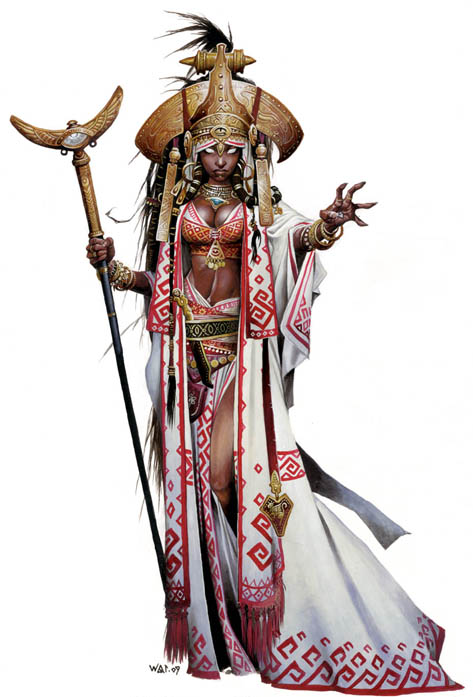 |
| Illustration by Wayne Reynolds |
Divine Magic
Cleric, Oracle, Inquisitor, Paladin; Druid, Shaman, Ranger
Compared to arcane spellcasters, divine casters have it easy. They don't need spellbooks, can use armour without worrying about spell failure, and prepared divine casters like clerics and druids know every divine spell that it is possible for them to cast. Need a niche spell to pull off a clever strategy? If you have enough time, they can just prepare it and you're good. They even have better health and attack bonuses than the arcane classes! (Prepared divine casters, like oracles, do have a limited amount of known spells, like sorcerers.)
Much of their magic still uses verbal and somatic components, making them susceptible to the same things that shut down arcane spellcasters. In addition, their magic requires a divine focus - a holy symbol for the more religious classes, or a sprig of mistletoe for those of a natural persuasion. Deprive them of their focus, and they can't cast spells. They are easy and cheap to replace, unless you want them to be really fancy.
I personally think it is silly that the three nature-focused spellcasters are lumped in with the divine casters, and in my games I usually make it hard for each group to recognise spells cast by the other - like how arcane and divine spellcasters struggle to recognise each other's spells.
Mechanically, there's not a lot of difference between arcane, divine and nature-divine magic, it's more of a story thing that needs to be played up by the GM and players for it to actually be relevant. Psychic magic, on the other hand...
 |
| Illustration by Tomasz Chistowski |
Psychic Magic
Psychic, Occultist, Spiritualist
Psychic magic is both elegant and problematic. D&D's psychic classes had spell-like powers that worked completely differently to other spellcasters. Pathfinder decided that they didn't want people to have to learn a whole new system of 'spellcasting'. So they decided that psychic magic would work just like arcane magic, with a two key differences.
Instead of the normal components, psychic magic uses emotion and thought components. This means that most of the usual ways to stop spellcasters, like silence and binding their hands, doesn't work on them. But, anything that messes with their emotions - like a fear spell - will shut off their ability to cast. The intense thought required also means they have difficulty casting defensively, making melee combat even less desirable for them than it is for wizards.
Secondly, all psychic classes use spontaneous casting. Prepared casting for psychic magic does not exist.
The problem with psychic magic being slotted into the game this way is that, despite the fact that you can always tell when a spellcaster is casting a spell, the game doesn't explain how this works for psychic magic. Wizards, clerics and druids visibly move their hands and mutter incantations, but psychics do not. You can't see the psychic components. So we have to come up with our own explanation. Perhaps their eyes glow blue, or mystical sigils appear in the air around them, or you just get this nagging feeling that the guy in the corner is trying to read your mind. It's not hard to come up with something fun for it, but it makes for a lot of initial confusion when you are trying to work out how to play one, as it isn't brought up at all, and you have to go searching through forums to find an official answer, that yes, you can always tell.
 |
| Illustration by Wayne Reynolds |
Alchemy
Alchemist, Investigator
Alchemy is actually just arcane magic. However, the mechanics used by alchemists and investigators (a class inspired by Arkham Horror) circumvent many of the limitations of arcane magic. They actually 'cast' all their spells at the beginning of the day, by creating extracts, which basically act as potions that they can later drink. While preparing extracts requires components, drinking an extract does not, and has no risk of spell failure. Alchemists and investigators can basically cheat their way around the restrictions by only putting on their armour after preparing extracts, and don't care about Silence. They are not without drawback - that their spell list is a lot more limited than wizards or sorcerers, mostly defensive spells that affect only them, and lack the three highest spell levels.
In all other ways, alchemists and investigators mirror wizards - they have a formula book with all their extracts written down, and they prepare them in advance.

Tuesday, 23 January 2018
Dungeoneering: The Cleric Conundrum
“So who is going to
play the cleric this time?” A phrase that was common in early
editions of Dungeons & Dragons. It was hard to heal damage
without access to magical healing, and clerics were the only class
that could do it well. So someone always had to play the cleric.
Which is kind of boring.
 |
| A typical dwarven cleric by Chris Seaman |
Technically, you can play
Pathfinder without a dedicated healer. I know, because I've played in
a group that pulled it off. You just have to play the right
combination of classes. In my game we had a paladin, witch (me),
alchemist and wizard. You may notice that everyone except the wizard
has self-healing. My witch had the healing hex and quite a few cure
spells, which was normally enough to keep the wizard alive, but in a
pinch the paladin could channel. I'd say you need to know what you're
doing to pull it off, but...none of us had actually played Pathfinder
before. Which was why I was under the mistaken impression that
witches were actually good at healing. So it is possible – but not
very advisable, as I suspect our DM went easy on us. I just can't get
him to admit it.
So how do you actually
fix this cleric issue? Dungeons & Dragons tried to remove it in
4e (shorthand for 4th edition) by changing how the healing
system worked – they made it much easier to naturally regain
hitpoints out of combat. They created the five minute short rest,
which allowed them to regain health based on their hit dice (the dice
you use to determine your health when making a character). They also
reduced the amount of healing clerics could deal out, and gave some
nifty healing powers to other classes. This worked well on the
surface. But 4e Edition suffered from too much homogenisation –
people complained all the classes felt too similar too each other.
Which is still boring.
So in 5e they revamped healing again, and this time I think they got it right. It's not as easy to heal as it was in 4e, as short rests are now an hour (so you can't stop to rest between every battle), you have less hit dice to use on healing during short rests, and you don't always get them all back after a long rest. Life domain clerics are still the best healers, having access to mass healing via channel divinity - but they are not essential. Bards and druids are now as good at healing as most other clerics, especially with the flexibility of Cure Wounds and the existence of the new spell Healing Word that can be cast as a bonus action. Even non-spellcasters can get in on the action by taking a healing feat.
 |
| Druid & Bard by Tim Kings-Lynne |
So in 5e they revamped healing again, and this time I think they got it right. It's not as easy to heal as it was in 4e, as short rests are now an hour (so you can't stop to rest between every battle), you have less hit dice to use on healing during short rests, and you don't always get them all back after a long rest. Life domain clerics are still the best healers, having access to mass healing via channel divinity - but they are not essential. Bards and druids are now as good at healing as most other clerics, especially with the flexibility of Cure Wounds and the existence of the new spell Healing Word that can be cast as a bonus action. Even non-spellcasters can get in on the action by taking a healing feat.
Pathfinder, on the other
hand, took a different tack and created the oracle class. Technically
the life oracle uses the main healing mechanic of the cleric –
channel positive energy. Which means it's basically the same class,
right? Well, no. Because somehow, playing an oracle feels totally
different to cleric. Maybe it's because their casting is spontaneous
like a sorcerer (and based on charisma, which is nice, because
channel is charisma-based too). Maybe it's because they are dedicated
to an ideal (called a mystery) rather than a specific god.
Maybe it's because they all suffer from a curse, which gives a really
nice hook to build a character around – as opposed to clerics,
whose hook is usually the god they follow. Whereas clerics feel
strictly religious, oracles are more like that friend you have who
talks about being in tune with the universe.
 |
| Oracle by Wayne Reynolds |
More recently, the
Advanced Class Guide gave us a third class that can play healer –
the shaman. The shaman is an strange hybrid of the witch and druid
classes. She gains magic and hexes from a familiar, like a witch,
casts nature-based divine spells like a druid, and has a feature
called spirits, based, for some reason, on the oracle's
mystery feature. Shaman dedicated to the life spirit get (of
course) channel positive energy. But the hexes she gains are an odd
twist – giving her the ability to reduce the amount of healing an
enemy can receive, completely prevent healing for a short time, or
drain her own health to heal an ally. Shamans bring a very
nature-based feeling to the healing game, one that might leave you
suspicious that they are not very nice. Shaman is notable for being
the only class that allows an evil character to channel positive
energy. Nature, it seems, doesn't really care about good or evil.
So the next time you find
yourself needing to play a healer, remember, cleric is not your only
option! D&D players can go with bard or druid, whilst Pathfinder
players can pick oracle or shaman.
Friday, 12 January 2018
Dungeoneering: Solving Problems Creatively
People often ask writers where their
ideas come from. Its a difficult question to answer, as when you are
creating stories, you don't often stop to think where your ideas come
from. But I have noticed something important: the best ideas happen
when you are trying to solve a problem.
In the past, D&D has suffered from
the 'cleric problem'. Healing was vital, and the only class that
could be a decent healer was the cleric, meaning that every party of
adventueres had to have a cleric. Which tends to get a bit boring,
especially if you have become the person who usually plays the
healer. D&D solved this problem by making healing less important
and also nerfing cleric healing to bining it in line with other
classes. Pathfinder, on the other hand, solved this by giving us fun,
viable alternatives to the cleric: the oracle and shaman. But this
means there still has to be a healer in every party.
Unfortunately, the cleric in my first
campaign was often absent due to work commitments, leaving the group
without healing. I solved this by giving the cavalier a powerful
artifact that mimicked the channeled healing of clerics and oracles.
As this was a Plane Shift campaign based on Zendikar (a world from
Magic: the Gathering) I called the artifact an Angelheart
Vial (based on a card from MtG).


But where exactly does an Angelheart
Vial come from, I wondered? This is the first important point: after
you solve the problem mechanically, you need to find a storyline
reason for the solution to exist. An Angelheart Vial, I decided, was
the crystallised heart of a slain angel. But not just any angel, this
was one on the level of the legendary angels of Zendikar – Iona and
Linvala. The angel was named Numa, and was slain in battle against
the mighty Eldrazi Titan known as Emrakul. There you go, a cool
little tidbit, but not terribly important in the grand scheme of
things.
Fast forward to a few months later, and
one of my players is wanting to play a fetchling character. The
problem is, fetchlings are not a thing that exists on Zendikar. These
days I'd just refuse – you don't need to play a fetchling when you
have access to unique Zendikar races like kor, merfolk and sphinxborn
– but back then I was in my 'you must give the players what they
want' phase. The main problem was that fetchlings are an outsider
race linked to the Plane of Shadows. D&D and Pathfinder use a
planar structure consisting of the material realm with other planes
overlaying it (like ethereal and shadow) and higher planes stacked
around it (like the elemental planes, heaven, hell, and so on). MtG,
on the other hand, uses a multiverse model, where each plane is it's
own distinct world, basically a series of unconnected material
planes. In this model, the concept of a shadow plane doesn't make
sense.
I had already discarded the idea of
removing the traditional planes from Pathfinder. There are a number
of spells that rely on the shadow plane (like Shadow Walk) or
ethereal plane (like Blink) to function, and there is the
concept of creatures called Outsiders, named because the come from
other planes. Outsiders include everything from angels and demons to
elementals of all flavours, and even include some playable races like
fetchlings and tieflings. These creatures interact with spells like
Summon Monster and
Dismissal, with entire
classes being built around the mechanics involving them. Altering all
these creatures was a substantially larger undertaking than I was
willing to undertake.


Which meant I had
to come up with a way to include planes, but not make them actual
planes. There was a possible solution for the Outsider problem, as
angels and demons in MtG are currently described as 'mana
constructs', beings made out of pure mana. When they 'die', their
essence or mana is said to return to the lands that they were created
from in the first place. Could lands and mana stand in for the idea
of an overlapping Shadow Plane?
This is the second important point:
When you have a bunch of semi-connected problems, what you do is
smoosh them all together and make a story out of it.
I didn't have the answer to everything yet, but I could come up with
a solution that included black mana, demons, fetchlings and the
Shadow Plane.
I know all sorts of obscure Magic lore,
so I knew that the concept of a shadow plane did actually exist, back
when Magic was more like D&D. Hidden away in really old stories
about Leshrac are ideas hinting at the existence of a shadow realm,
and that people have become trapped inside it. Though never
officially explained, it is theorised that this has something to do
with creatures called the soltari, a race encountered on the plane of
Rath that had been abducted to populate the realm, but had somehow
ended up stuck out-o-phase with the rest of the world. This is
represented on the cards as a mechanic called 'shadow'. Aha! Rath is
indirectly linked to Zendikar due to the fact that another race
called the kor was also kidnapped to poulate Rath – and the kor
were originally from Zendikar. What if, I thought, the soltari were
also from Zendikar?
And so, pulling disparate threads
together, I ended up with the following:
When the Archangel Numa died in
battle against Emrakul, her spirit end up in the Shadowlands, a black
mana realm populated by undead, demons and madmen. Being a protective
deity, she took up the cause of the soltari, a group of humanoids
also trapped in the shadow realm of Zendikar, who were slowly going
crazy from the madness-inducing realm. Crafting a blade from her
remaining light, and the shadows of her new home, she fought back the
undead and darkness long enough for the soltari to build a fortified
city called Solitaire. Leaving her Sword of Light & Shadow in the
temple the soltari built to honour her, she vanished from mortal
sight, but the people of Solitare have been under what is obviously
divine protection ever since, leading many to believe she still
protects the city in unseen ways.

And just like that, I have a god, a
plane, a fleshed out idea of what black magic involves on Zendikar, a
new city to populate with people, a powerful relic, and a great
conflict between the soltari and the undead for the players to get
drawn into.
You may recognise that I've taken ideas
from all over the place. This is part of the third important point –
you don't have to come up with it all yourself. You don't even have
to come up with it all beforehand. A lot of the time I found myself
making things up on the spot as players asked me questions. I
intended to avoid anything to do with planar travel, but my players
ended up spending a siginificant amount of time in the Shadowlands,
and even gave me ideas for putting this all together (though they
didn't realise it).
Wednesday, 22 June 2016
Finding the Path: Artifacts of Great Power
While Pathfinder has a lot of guides to creating customised magic items, from mixing and matching weapon special abilities, to the rules for building intelligent items, sometimes you want something that just doesn't have any rules similar to what you actually want. And as cool as the Janus Trident and the Angelheart Vial are, they are not the first things that spring to mind when thinking about artifacts from Magic: the Gathering.
 |
| Illustration by Wayne Reynolds |
Wednesday, 15 June 2016
Finding the Path: Zendikar's Origins
Zendikar is one of Magic's oldest planes, with the first Eldrazi invasion taking place just over a thousand years before the birth of Urza on the plane of Dominaria (an event generally used as year 0 in Magic chronology). However, Zendikar's great age is retroactive, as the plane was first referred to in The Purifying Fire, a novel only published in 2009.
While we know how far back the history goes, we know relatively little about that history. We know that the first Eldrazi invasion took place 6000 years before the present day. The Eldrazi are a mysterious extraplanar race, based partly on HP Lovecraft's Cthulu, that devour entire planes of existence by consuming the mana in the land, leaving behind nothing but lifeless wastes. The most dangerous of them are the three Eldrazi titans - the all-consuming Ulamog, the reality-warping Kozilek and the nigh-invincible time-bending Emrakul.


While we know how far back the history goes, we know relatively little about that history. We know that the first Eldrazi invasion took place 6000 years before the present day. The Eldrazi are a mysterious extraplanar race, based partly on HP Lovecraft's Cthulu, that devour entire planes of existence by consuming the mana in the land, leaving behind nothing but lifeless wastes. The most dangerous of them are the three Eldrazi titans - the all-consuming Ulamog, the reality-warping Kozilek and the nigh-invincible time-bending Emrakul.


Wednesday, 8 June 2016
Finding the Path: Priceless Treasures
Magic: the Gathering has always had powerful items known as artifacts. The MtG world of Zendikar, being partly based on D&D, was supposed to be full of very dangerous locations filled with amazing treasures and items of great power. It even used the tagline "Deadly Perils, Priceless Treasures".
Which meant that, if I was running a campaign on Zendikar, there had to be some really cool, powerful treasures for people.

The first magical item I made as a cool reward was the Trident of Ula, a +1 guided trident, meaning it had a +1 bonus to attack and damage, and used the wielder's wisdom modifier instead of the usual strength modifier. It is somewhat unclear whether guided property is a legitimate Pathfinder rule or not, but, hey, I am the GM, and I can do whatever I want. Yes, it is a rather powerful and expensive weapon to give a low-level character, and generally, giving that to a single character can easily make them outclass the rest of the party, which is bad, as every player should get moments to shine. However, I was giving it to Dhamiran's merfolk cleric, Ler Mimir, who was not really supposed to be stabbing things in close combat. He had to pick his moments, and either use it to counter a charging enemy, or as a way to finish off an enemy already wounded by the other party members. It would be difficult for him to outclass the damage-dealers, and the party seemed to enjoy his trident-stabbing shenanigans anyway. Here is the trident I made:
Janus Trident
Aura: moderate evocation and necromancy
Caster Level: 10th
Slot: Wielded
Price: 18000gp
Description
Few know the truth of the connection between the gods Ula and Ulamog, and virtually none have heard whispers of how Ula takes the dark weapons of Ulamog, and bends them towards the light. The Janus Trident is a +1 conductive guided trident made of gleaming white coral and pink pearl that is inscribed with a faintly glowing symbol of Ula. As a standard action, the wielder can transform it into a +1 vicious guided trident made of chalky grey coral and black pearl inscribed with the symbol of Ulamog. The trident can be transformed back again as a standard action.

Well...that's not quite what I said it was. I may not have been completely honest with my players about some of their items. See, one of the major villains of the campaign, Lucrecia, has been planting cursed items in the path of the heroes, in order to gain an advantage if she is forced to fight them directly. This has included a ring that can bring the wearers fears to life, a hammer that casts daylight at inopportune moments, and the Janus Trident - originally a Trident of Ulamog under an illusion that made it appear to belong to Ula. But something (or Someone) has subverted Lucrecia's plans, and the illusion has somehow become reality.
Though the Janus Trident was something I planned out beforehand, the second item was something I had to throw together quickly when it became apparent that (with Dhamiran temporaily absent for a few weeks due to work) the group needed more healing than a few potions could provide. Originally I planned to give the party a wand of mass cure wounds, however, it turns out that such a thing does not actually exist, due to it being an item that is far too powerful to allow. The only thing that would be able to duplicate such power would be some sort of artifact. Enter one of my favourite cards from Zendikar: the Angelheart Vial.

Initially, the vial, which I had to quickly invent in a couple of days, was just a 10-charge wand of mass cure light wounds. (I limited it to 10 because, it really is an immensely powerful ability for low level characters.) The archangel Iona would appear and gave it to Sir Eleassar without explanation. However, I decided I could do better than that. Due to the fact that Sir Elessar was suffering from rolling really bad will saves against fear, and ended running away from enemies quite a lot, which was bad cause he was supposed to be the groups tank, I decided to make something that boosted his will save, gave me a panic button to press if he still failed, gave the group an extra way to deal with the upcoming enemy ghosts, and tied into his characters backstory, allowing his superiors in the Order of the Reliquary to go 'Well done on obtaining a powerful relic, here, you are promoted to knight-captain.'
I trawled through Ultimate Equipment for the rules about building intelligent items, and constructed a pretty powerful artifact with some powerful abilities and a really cool backstory. Sadly, none of my players have yet tried to work out what exactly the angelheart vial is, and why she seems to be able to cast spells of her own accord. The party has also consistently stymied my attempts to reveal this, by ensuring that Elessar never meets anyone who would recognise what she is, meaning her true nature has remained a secret. So then, here, for the first time, are the full stats and backstory of Numa's Heart:
Numa's Heart
Purpose: To defend the interests of Numa.
Aura: Strong Abjuration
Caster Level: 11th
Slot: Stone
Price: 25000gp
Stats
Alignment: neutral good
Ego: 11
Senses: 30ft
Intelligence 13, Wisdom 14, Charisma 11.
Communication: empathy (Common, Celestial)
Description
The archangel Numa was slain by Emrakul during the fall of the city of Nal-Kashel, but her diamond heart was recovered by Linvala, and Iona fashioned it into the most powerful angelheart vial ever made. Despite her power, Numa's Heart was kept secretly in the Sky-Ruins of Emeria during the second Eldrazi War. For reasons known only to herself, Iona gifted the vial to Sir Elessar of the Reliquary to aide him and his companions in their battle with a demonic barghest. Unlike most intelligent items, Numa's Heart is secretive, and prefers to conceal her true nature, demanding very little of her wearer, only using her spells and voicing her opinion in dire circumstances. Numa's Heart grants the wearer a +1 sacred bonus to their Will save and functions as a wand of mass cure light wounds with 10 charges. She can be used as an abjuration implement by occultists and knights of the Reliquary. In addition, Numa's Heart can cast spells of her own accord.
Spells
11th level divine caster:
3/day - remove fear
1/day - spirit-bound blade
at will - call spirit (purpose only)
Which meant that, if I was running a campaign on Zendikar, there had to be some really cool, powerful treasures for people.

The first magical item I made as a cool reward was the Trident of Ula, a +1 guided trident, meaning it had a +1 bonus to attack and damage, and used the wielder's wisdom modifier instead of the usual strength modifier. It is somewhat unclear whether guided property is a legitimate Pathfinder rule or not, but, hey, I am the GM, and I can do whatever I want. Yes, it is a rather powerful and expensive weapon to give a low-level character, and generally, giving that to a single character can easily make them outclass the rest of the party, which is bad, as every player should get moments to shine. However, I was giving it to Dhamiran's merfolk cleric, Ler Mimir, who was not really supposed to be stabbing things in close combat. He had to pick his moments, and either use it to counter a charging enemy, or as a way to finish off an enemy already wounded by the other party members. It would be difficult for him to outclass the damage-dealers, and the party seemed to enjoy his trident-stabbing shenanigans anyway. Here is the trident I made:
Janus Trident
Aura: moderate evocation and necromancy
Caster Level: 10th
Slot: Wielded
Price: 18000gp
Description
Few know the truth of the connection between the gods Ula and Ulamog, and virtually none have heard whispers of how Ula takes the dark weapons of Ulamog, and bends them towards the light. The Janus Trident is a +1 conductive guided trident made of gleaming white coral and pink pearl that is inscribed with a faintly glowing symbol of Ula. As a standard action, the wielder can transform it into a +1 vicious guided trident made of chalky grey coral and black pearl inscribed with the symbol of Ulamog. The trident can be transformed back again as a standard action.

Well...that's not quite what I said it was. I may not have been completely honest with my players about some of their items. See, one of the major villains of the campaign, Lucrecia, has been planting cursed items in the path of the heroes, in order to gain an advantage if she is forced to fight them directly. This has included a ring that can bring the wearers fears to life, a hammer that casts daylight at inopportune moments, and the Janus Trident - originally a Trident of Ulamog under an illusion that made it appear to belong to Ula. But something (or Someone) has subverted Lucrecia's plans, and the illusion has somehow become reality.
Though the Janus Trident was something I planned out beforehand, the second item was something I had to throw together quickly when it became apparent that (with Dhamiran temporaily absent for a few weeks due to work) the group needed more healing than a few potions could provide. Originally I planned to give the party a wand of mass cure wounds, however, it turns out that such a thing does not actually exist, due to it being an item that is far too powerful to allow. The only thing that would be able to duplicate such power would be some sort of artifact. Enter one of my favourite cards from Zendikar: the Angelheart Vial.

Initially, the vial, which I had to quickly invent in a couple of days, was just a 10-charge wand of mass cure light wounds. (I limited it to 10 because, it really is an immensely powerful ability for low level characters.) The archangel Iona would appear and gave it to Sir Eleassar without explanation. However, I decided I could do better than that. Due to the fact that Sir Elessar was suffering from rolling really bad will saves against fear, and ended running away from enemies quite a lot, which was bad cause he was supposed to be the groups tank, I decided to make something that boosted his will save, gave me a panic button to press if he still failed, gave the group an extra way to deal with the upcoming enemy ghosts, and tied into his characters backstory, allowing his superiors in the Order of the Reliquary to go 'Well done on obtaining a powerful relic, here, you are promoted to knight-captain.'
I trawled through Ultimate Equipment for the rules about building intelligent items, and constructed a pretty powerful artifact with some powerful abilities and a really cool backstory. Sadly, none of my players have yet tried to work out what exactly the angelheart vial is, and why she seems to be able to cast spells of her own accord. The party has also consistently stymied my attempts to reveal this, by ensuring that Elessar never meets anyone who would recognise what she is, meaning her true nature has remained a secret. So then, here, for the first time, are the full stats and backstory of Numa's Heart:
Numa's Heart
Purpose: To defend the interests of Numa.
Aura: Strong Abjuration
Caster Level: 11th
Slot: Stone
Price: 25000gp
Stats
Alignment: neutral good
Ego: 11
Senses: 30ft
Intelligence 13, Wisdom 14, Charisma 11.
Communication: empathy (Common, Celestial)
Description
The archangel Numa was slain by Emrakul during the fall of the city of Nal-Kashel, but her diamond heart was recovered by Linvala, and Iona fashioned it into the most powerful angelheart vial ever made. Despite her power, Numa's Heart was kept secretly in the Sky-Ruins of Emeria during the second Eldrazi War. For reasons known only to herself, Iona gifted the vial to Sir Elessar of the Reliquary to aide him and his companions in their battle with a demonic barghest. Unlike most intelligent items, Numa's Heart is secretive, and prefers to conceal her true nature, demanding very little of her wearer, only using her spells and voicing her opinion in dire circumstances. Numa's Heart grants the wearer a +1 sacred bonus to their Will save and functions as a wand of mass cure light wounds with 10 charges. She can be used as an abjuration implement by occultists and knights of the Reliquary. In addition, Numa's Heart can cast spells of her own accord.
Spells
11th level divine caster:
3/day - remove fear
1/day - spirit-bound blade
at will - call spirit (purpose only)
Wednesday, 1 June 2016
Finding the Path: Storm, Fire and Shadow
But what exactly are planes in Pathfinder, and how do they work? It is fairly complicated, so let us start at the beginning.
 |
| A djinni of the Air Plane. Illustration by Jesper Ejsing. |
What we would define as reality - the world around us, and the material objects that exist or live in it - is called the Material Plane in Pathfinder. You could say that the Material Plane is in the middle, and the other planes are found around or above it - but not in a directional sense, as you can't point and say 'that way to the fire plane'. You can usually only travel to the other planes using magic.
But even that is a simplification. The Material Plane is only one half of the 'middle'. The other half is a place called the Shadow Plane, a sort of darkened reflection of the Material Plane, sharing it's geography, but with muted colours and sounds, different nations and cities, and populated with a worryingly large number of undead things. This makes sense, as the Shadow Plane is actually powered by a small plane called the Negative Energy Plane which sits at it's centre, and is the source of unlife. Conversely, the Positive Energy Plane is the source of life, and is in the centre of the Material Plane - though, again, these are figurative rather than physical centres.
Sometime in the past, a number of humans found themselves trapped on the shadow plane. After generations of exposure to the planes unusual umbra, they have changed to the point that they are now a separate race to humanity - known as the fetchlings, their skin and hair are various tones of grey, and their pigment-less irises are pale yellow.
 |
| A marid of the Water Plane. Illustration by Jesper Ejsing. |
The Material and Shadow Planes are connected together by a third plane - the Ethereal Plane - which is not really a full plane, as it overlays the other two and has no geography as such. In Pathfinder, the Ethereal Plane is the place your mind goes while you are asleep, and dreaming people reshape the plane around them subconsciously. Spellcasters also make use of the plane - spells like blink, for example, can partially shift the caster into the Ethereal Plane, causing weapons to pass harmlessly through their form. Alternately, it's overlapping nature can be used as a means to travel between the Material and Shadow Planes.
Around this core of Material-Ethereal-Shadow are the four elemental planes - Air, Earth, Water and Fire. Each of these planes have unique geography - the air plane is composed entirely of sky with no true land - unique inhabitants, and even entire civilisations. The most well known elemental inhabitants are the outsiders known as genies. There are four kinds - one on each plane.
Air is home to the djinn, the most well known of the four, and the only kind that are good-aligned. Djinn famously have the ability to grant wishes to those of the Material plane. Like many other outsiders, djinn have mixed with humans, giving rise to an elf-like geniekin race called the sylph, lithe and clever but carefree humanoids, with an affinity for air magic, and a penchant for spying and eavesdropping, which they do not out of maliciousness, but from sheer curiosity about everything.
 |
| An efreeti of the Fire Plane. Illustration by Jesper Ejsing. |
Fire is home to the evil efreet, also known for wish-granting, though wishes granted by them often have a way of going awry, leading to the famous phrase 'be careful what you wish for'. Their humanoid descendants, the ifrit, are often mistaken for tieflings, as they often have horns, fiery hair or black-scaled skin on their arms. They tend to be passionate about everything, and fiercely independent.
Unlike djinn and efreet, realtively little is known about the marid of the Water Plane, or the shaitan of the Earth Plane. They are generally neutral, not taking sides in the battle between good and evil. They also have humanoid descendents - the undine, who look very similar to the legged merfolk of Magic: the Gathering, and the stubborn and stony oread who, it is said, only get along well with the dwarves.
All the planes I have mentioned so far make up what is called the Inner Sphere - there are actually another nine planes termed the Outer Sphere, which is where things like angels and archons come into the narrative. But I have gone on long enough. I will just mention that the planes have been a slight problem in adapting Pathfinder to Magic, as the term 'plane' has a very different meaning in Magic. It's not quite as easy as just saying 'there are no ethereal or elemental planes', as a lot of mechanics make reference to these planes - including the spell blink making you shift rapidly between the Ethereal and Material Planes, and the large group of beings called outsiders that are very tied to the planar mechanics. It is something I am still working on moving across.
 |
| A shaitan of the Earth Plane. Illustration by Jesper Ejsing. |
Wednesday, 25 May 2016
Finding the Path: Psychic Thoughts
I don't like the sorcerer class. I understand that they are more flexible in battle than wizards, but having access to a very limited number of spells that you can't increase by adding scrolls to a spellbook...just feels bad to me.
So in theory, I shouldn't like the psychic class either, as it is similar in many ways. But I've been playing a psychic for a while now, and I am really enjoying it.
The main reason I wanted to try playing one is a spell called Burst of Adrenaline, which gives a massive boost to a physical score (Strength, Dexterity or Constitution) for one round, with the drawback of being fatigued on the next round. It's like a mini version of the barbarian's rage, and is one of the few spells in Pathfinder that you can cast as an immediate action (an instant spell for those of you who play Magic). Just by itself, it made me want to try out the new 'psychic magic' rules.
Like a sorcerer, the psychic is a full nine level spellcaster with a bad attack bonus. It also has a sorcerer-bloodline-like feature called a psychic discipline, that grants a small number of bonus spells and spell-like abilities. Like the sorcerer, their magic is innate rather than learned. But unlike a sorcerer, who uses charisma, their magic is keyed off of intelligence.
The psychic is very much a master of the mind, and even though they have innate magic, there is the feeling that it is not just handed out to them - it still requires intense study and discipline to pull off the the things they do. And perhaps that is part of the reason I like them so much, as it doesn't quite feel like your character just won the genetic lottery.
Psychics have another class feature, borrowed from the sword-and-sorcery magus class - a phrenic pool they can spend to amplify their spells, though, theirs is less flexible than the magus' arcane pool.
The psychic has a number of advantages over the sorcerer. Many sorcerer spells require the sorcerer to actually aim at the target, requiring an attack roll. These 'ray' spells usually ignore armour, but even with that bonus, a sorcerer can miss and waste the spell. Psychics hardly have any ray spells, most of their stuff just hits, because, they're messing directly with the opponent's head. Couple that with the fact that their signature spell mind thrust easily out-damages magic missile, and they start to look rather scary.
The sorcerer's arcane magic has verbal and somatic components - basically, you need to be able to speak the magic words and move your hands in the correct manner to cast your spells. All very Harry Potter. This means that sorcerers can't wear much armour, which restricts movement, and if you can silence them or stop their hands moving you can shut them down completely.
But the psychic uses psychic magic instead of arcane magic, which requires thought and emotion components. Tying up a psychic's hands is ineffective, and casting silence on them does nothing to stop their magic. In fact, psychics can actually cast silence themselves, and it's actually a good strategy for them drop a zone of silence if they find themselves duelling a wizard. In addition, they can wear full plate armour without it messing up their spells.
This all seems pretty powerful - and it is - but psychics do have weaknesses. Like the witch, their reliance on mind-affecting spells means that they struggle against stuff that is immune to mind magic, like plants, vermin, constructs and - undead. And you tend to fight a lot of undead in Pathfinder. While they can circumvent the undead thing by learning an ampification, it's still something they have to spend extra resources on doing, and they still get stuck being useless against the other mindless stuff.
They are also lacking in the AOE department, not having access to things like fireball, lightning bolt, or the ever-popular burning hands. The only decent spell they have for this is sonic scream, which has it's own drawbacks.
Their spellcasting can be shut down by anything that messes with their emotions, like the rather common monster ability to cause fear, and their thought components make concentration checks nearly twice as difficult unless they spend actions clearing thier mind. Good like with casting that spell defensively.
Overall, I think the class is really well made and pretty balanced. In addition, it doesn't feel like any other Pathfinder class (even though it heavily borrows ideas from a few) and so carves out it's own little space. And it's a really fun space. Did I mention you get to make heads explode?
So in theory, I shouldn't like the psychic class either, as it is similar in many ways. But I've been playing a psychic for a while now, and I am really enjoying it.
 |
| Illustration by Tomasz Chistowski |
The main reason I wanted to try playing one is a spell called Burst of Adrenaline, which gives a massive boost to a physical score (Strength, Dexterity or Constitution) for one round, with the drawback of being fatigued on the next round. It's like a mini version of the barbarian's rage, and is one of the few spells in Pathfinder that you can cast as an immediate action (an instant spell for those of you who play Magic). Just by itself, it made me want to try out the new 'psychic magic' rules.
Like a sorcerer, the psychic is a full nine level spellcaster with a bad attack bonus. It also has a sorcerer-bloodline-like feature called a psychic discipline, that grants a small number of bonus spells and spell-like abilities. Like the sorcerer, their magic is innate rather than learned. But unlike a sorcerer, who uses charisma, their magic is keyed off of intelligence.
The psychic is very much a master of the mind, and even though they have innate magic, there is the feeling that it is not just handed out to them - it still requires intense study and discipline to pull off the the things they do. And perhaps that is part of the reason I like them so much, as it doesn't quite feel like your character just won the genetic lottery.
 |
| Illustration by Rogier van der Bank |
Psychics have another class feature, borrowed from the sword-and-sorcery magus class - a phrenic pool they can spend to amplify their spells, though, theirs is less flexible than the magus' arcane pool.
The psychic has a number of advantages over the sorcerer. Many sorcerer spells require the sorcerer to actually aim at the target, requiring an attack roll. These 'ray' spells usually ignore armour, but even with that bonus, a sorcerer can miss and waste the spell. Psychics hardly have any ray spells, most of their stuff just hits, because, they're messing directly with the opponent's head. Couple that with the fact that their signature spell mind thrust easily out-damages magic missile, and they start to look rather scary.
The sorcerer's arcane magic has verbal and somatic components - basically, you need to be able to speak the magic words and move your hands in the correct manner to cast your spells. All very Harry Potter. This means that sorcerers can't wear much armour, which restricts movement, and if you can silence them or stop their hands moving you can shut them down completely.
But the psychic uses psychic magic instead of arcane magic, which requires thought and emotion components. Tying up a psychic's hands is ineffective, and casting silence on them does nothing to stop their magic. In fact, psychics can actually cast silence themselves, and it's actually a good strategy for them drop a zone of silence if they find themselves duelling a wizard. In addition, they can wear full plate armour without it messing up their spells.
 |
| Illustration by Wayne Reynolds |
This all seems pretty powerful - and it is - but psychics do have weaknesses. Like the witch, their reliance on mind-affecting spells means that they struggle against stuff that is immune to mind magic, like plants, vermin, constructs and - undead. And you tend to fight a lot of undead in Pathfinder. While they can circumvent the undead thing by learning an ampification, it's still something they have to spend extra resources on doing, and they still get stuck being useless against the other mindless stuff.
They are also lacking in the AOE department, not having access to things like fireball, lightning bolt, or the ever-popular burning hands. The only decent spell they have for this is sonic scream, which has it's own drawbacks.
Their spellcasting can be shut down by anything that messes with their emotions, like the rather common monster ability to cause fear, and their thought components make concentration checks nearly twice as difficult unless they spend actions clearing thier mind. Good like with casting that spell defensively.
 |
| Illustration by Wayne Reynolds |
Overall, I think the class is really well made and pretty balanced. In addition, it doesn't feel like any other Pathfinder class (even though it heavily borrows ideas from a few) and so carves out it's own little space. And it's a really fun space. Did I mention you get to make heads explode?
Wednesday, 18 May 2016
Finding the Path: Off the Chain
In my previous posts about the classes of pathfinder, I mentioned a few of the classes had flaws: the rogue is often bad in combat, the fighter is a bit boring, and the barbarian requires far more maths than you should have to think about when playing a melee smasher with anger problems.
On the flip side, there is the summoner, a class I have barely mentioned. Mistakes were made. They gain their arcane spells more slowly than wizards, witches and sorcerers, to make up for the fact that they have an animal-companion-like creature called an 'eidolon' that is very good at fighting. But, their spell list grants them many arcane spells at a lower level than the other arcane casters, which defeats the entire idea of gaining spells more slowly. The summoners early spells also let them do crazy things like make wands of haste, a spell that is normally too high level to put in a wand. And when you start hasting an eidolon, everyone else in the party may as well just go home.
On the flip side, there is the summoner, a class I have barely mentioned. Mistakes were made. They gain their arcane spells more slowly than wizards, witches and sorcerers, to make up for the fact that they have an animal-companion-like creature called an 'eidolon' that is very good at fighting. But, their spell list grants them many arcane spells at a lower level than the other arcane casters, which defeats the entire idea of gaining spells more slowly. The summoners early spells also let them do crazy things like make wands of haste, a spell that is normally too high level to put in a wand. And when you start hasting an eidolon, everyone else in the party may as well just go home.
Sunday, 15 May 2016
Magic & Pathfinder: The Vampires
When I was developing the racial rules for Pathfinders of Zendikar, I had to decide what to do with vampires. They are Zendikar's major black mana race, but straight up Pathfinder vampires are way too powerful to be used by players. Fortunately, there was a possibility - the dhampir race. Dhampir are half-human half-vampires, technically living, but treated as undead for the purposes of healing magic. I had a way to make the dhampir fit - but I had to pull out an old pet theory of mine. But lets go back a few years, to when I first started playing Magic.
 |
| Illustration by Adi Granov |
Wednesday, 11 May 2016
Finding the Path: Not From Around Here
Those of you who read my post on the classes of Pathfinder may have noticed that I left out a rather important core class: the monk. Monks have been a part of RPGs for a long time, but, being based on the Shaolin monks of China, they don't quite fit in with the rest of the base classes. And Pathfinder has acknowledged this to a degree - Sajan Gadadvara, Pathfinder's iconic monk character, is from the far land of Vudra, come to the Inner Sea in search of his missing sister. He is very much a stranger in a strange land. But...he is not the only one who has traveled far from home to the Inner Sea. The ninja Reiko walks beside people who think ninja only fairy-tales, while the ronin samurai Nakayama Hayato sticks to the code of 'honour is strength' despite his exile from his homeland. Both hail from Minkai, a place on the other side of the world to the Inner Sea.
Sunday, 8 May 2016
Magic & Pathfinder: The Maftet
Sometimes I get strange ideas in my head that I just can't let go. Case in point: the sphinxborn. It was pretty easy to get the five characteristic races for each of the colours of magic, as four and a half of them already existed in Pathfinder. (If you're counting, it's human, merfolk, vampire, goblin and elf.) But I wanted some sort of representation of the iconic creatures too. (Again, if you're counting, it's angel, sphinx, demon, dragon and hydra.)
For the white and black iconics it's pretty easy, as aasimir (humans with a bit of angel blood) and tieflings (humans with fiendish heritage) both have a storied history in Pathfinder. But the others were much harder. I'm still not sure how to pull off dragon and hydra (or if I should even try), but in preparing a Mul Daya related stuff for this week's Pathfinders of Zendikar I came across something interesting, called a maftet.

For the white and black iconics it's pretty easy, as aasimir (humans with a bit of angel blood) and tieflings (humans with fiendish heritage) both have a storied history in Pathfinder. But the others were much harder. I'm still not sure how to pull off dragon and hydra (or if I should even try), but in preparing a Mul Daya related stuff for this week's Pathfinders of Zendikar I came across something interesting, called a maftet.

Friday, 6 May 2016
Finding the Path: The Races of Zendikar
The major challenge of running a Pathfinder game set on the world of Zendikar, is making the world the players are in feel like Magic: the Gathering, and not just 'Pathfinder but on Zendikar'.
The first thing I had to do was work out what races the players are allowed to play. Zendikar doesn't have many of the fantasy staples - no dwarves, gnomes, halflings or orcs. This cuts out over half of the core Pathfinder races. Fortunately the original Zendikar had a bit of tribal theme to it, making the selection of player races pretty obvious - kor, merfolk, vampire, goblin, elf and human. Elf and human were the only core races on this list.
The first thing I had to do was work out what races the players are allowed to play. Zendikar doesn't have many of the fantasy staples - no dwarves, gnomes, halflings or orcs. This cuts out over half of the core Pathfinder races. Fortunately the original Zendikar had a bit of tribal theme to it, making the selection of player races pretty obvious - kor, merfolk, vampire, goblin, elf and human. Elf and human were the only core races on this list.
Saturday, 30 April 2016
Finding the Path: A Class Act
Pathfinder has a lot of classes to choose from. Some would say there are too many. When running a campaign, I have to decide which classes I am going to let people use. Some I leave out because they make little sense in the setting (such as monks or gunslingers) whilst others I ban due to them being far too powerful (cough-summoner-cough). I have come up with a list of twenty one classes that I am always fine with people playing. Here is a brief summary of each one.
Core Classes
Barbarian
Full Attack * Strength, Constitution
If you want to deal stupidly vast amounts of damage with a very large weapon, and be useless at virtually everything else, then the barbarian is your class. For a small number of rounds per day, the barbarian can go into a berserker-like rage, vastly increasing their strength and constitution, allowing them to wreck everything. Sadly, barbarians are fueled by math, as rage changes so many stats, and you will also be charging and power attacking which changes stuff even more. So be prepared for a lot of addition and subtraction.
Core Classes
 |
| Illustration by Wayne Reynolds |
Barbarian
Full Attack * Strength, Constitution
If you want to deal stupidly vast amounts of damage with a very large weapon, and be useless at virtually everything else, then the barbarian is your class. For a small number of rounds per day, the barbarian can go into a berserker-like rage, vastly increasing their strength and constitution, allowing them to wreck everything. Sadly, barbarians are fueled by math, as rage changes so many stats, and you will also be charging and power attacking which changes stuff even more. So be prepared for a lot of addition and subtraction.
Thursday, 21 April 2016
Finding the Path: Lessons from a new GM
I know there are some people out there thinking of being a GM (that's gamesmaster to those who don't know the lingo, the person that creates and runs a ropeplaying game campaign). But it can be a scary thing to do. So here are ten lessons I have learnt during my first campaign (which I am still running) called Pathfinders of Zendikar. Hopefully they will be useful, and maybe encourage you to take the leap into running your own.
Here are my players:
Sir Elessar - human cavalier (Richard)
Gwahir - loyal apex hawk
Ler Mimir - merfolk cleric of Ula (Dhamiran)
Tic-Tac - goblin rogue (Andrew)
Atlas - mul-daya elf sorcerer (George)
Lithios - human paladin (Matt)
 |
| Illustration by Tim Kings-Lynne |
1. The players never do what they are supposed to.
It became incredibly apparent in the very first session that my players were not going to follow the carefully laid out progress in the adventure book I was using. They were supposed to hang around in the town of Stoneforge and help the residents with a number of annoying problems, from goblin raids to giant crab attacks. Instead, they immediately rushed off to Emeria (which was pointless) and wanted to go raid the main goblin base (which would have gotten them killed). They ignored every in-game attempt on my part to get them to stay in the town, until I had to out-of-game say 'please stay in the town guys'. Which is not the best way to GM.
Subscribe to:
Posts (Atom)